


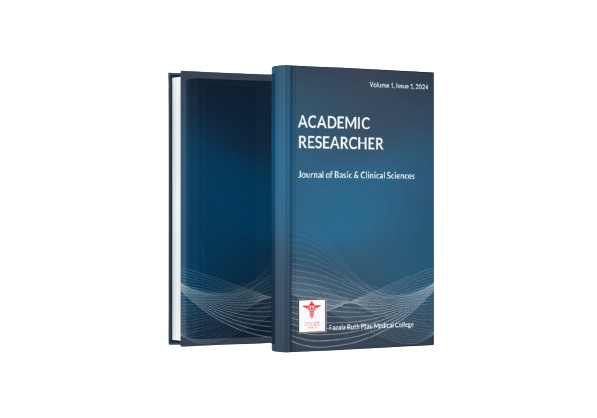
Academic Researcher
Journal of Basic and Clinical Sciences
Volume 03, Issue 01, 2026
An Official Journal of Fazaia Ruth Pfau Medical College, Air University
ISSN: 3008-0495 (Online)
ISSN: 3008-0487 (Print)
E-Publication Ahead
Surgical and Non-Surgical Causes of Abdominal Pain in Children
Memoona, Naima Rasool, Nasreen Ali
Acad Res. 2026
Abstract
Objective: To evaluate the surgical and non-surgical causes of abdominal pain in hospitalized children requiring pediatric surgical consultation.
Methods: This mixed retrospective–prospective study was conducted at PAF Hospital Faisal and Masroor Base, Karachi, from January 2022 to June 2024. Children admitted with abdominal pain of unclear etiology despite initial clinical evaluation and baseline investigations within the first 24 hours, for whom pediatric surgical consultation was sought, were included. Patients with an already established diagnosis or those presenting directly to pediatric surgeons were excluded.
Results: A total of 84 children were included, comprising 49 boys and 35 girls aged 1-12 years. The most common causes were nonspecific abdominal pain (n=21), constipation (n=16), urinary tract infection (n=8), mesenteric lymphadenitis (n=7), pneumonia (n=5), hepatitis/cholecystitis (n=4), acid peptic disease (n=4), typhoid fever (n=4), pancreatitis (n=3), and abdominal tuberculosis (n=3). Surgical conditions included appendicitis (n=4), incarcerated hernia (n=1), testicular torsion (n=1), intussusception (n=1), and adhesive subacute intestinal obstruction (n=2). Seven patients (8.3%) required surgical intervention, while intussusception was managed successfully with hydrostatic reduction. The remaining patients responded to conservative management with serial clinical observation.
Conclusion: Children presenting with undifferentiated abdominal pain require careful serial clinical assessment and timely surgical evaluation to avoid delayed diagnosis of potentially life-threatening surgical conditions.
Keywords
Abdominal pain in children, surgical causes, Acute Abdomen, Differential Diagnosis, Pediatric Surgery.
Cadmium Stress in Wheat: Monitoring Changes in Biochemical Attributes
Mariam Lodhi, Amina Kanwal
Acad Res. 2026
Abstract
Background and Objective: Cadmium (Cd), like all heavy metals, it causes drastic effects on the crops, especially wheat, the staple food of majority of populations worldwide. This study was designed to find out the effects of cadmium on the Biochemical Attributes of wheat fruit (Triticum aestivum L).
Methodology: In a pot experiment, randomized design study cadmium was applied as cadmium sulphate (CdSO₄) at doses of 0, 5, 10, 25, and 50 mg kg⁻¹ soil. Healthy seeds (Seed Certified Department, Lahore) were soaked/sowed in clay-loamy soil (1:3 humus to soil ratio) in 15 kg of soil pots. Plantation of twelve seeds per pot for each of the three replications of each treatment, and subsequently pruned to six seedlings, totaling 90 plants, watered regularly. Following extraction with 80% acetone, biochemical and physiological characteristics, were examined spectrophotometrically, Infra-Red Gas Analyzer (IRGA) was used to assess photosynthetic rate, stomatal conductance, and transpiration. ANOVA and treatment compared using Duncan’s Multiple Range Test were used to examine the results.
Results: Cadmium exposure showed negative impact on physiological and biochemical parameters of wheat. Severe oxidative stress was indicated by a sharp drop in chlorophyll a (79.17%) and b (2.44%) values. A 60% decrease in chlorophyll concentration was observed from 3.22±1.09 (T0) to 1.30±0.73 (T4). Carotenoids showed a significant decline from 7.28±0.03 (T0) to 2.09±0.06 (T4). Chlorophyll a showed statistically significant sensitivity to cadmium stress compared to carotenoids and chlorophyll b.
Conclusion: The photosynthetic pigments in the wheat cultivar Sehar-06 are considerably and dose-dependently inhibited by cadmium stress.
Keywords
Cadmium; Wheat; Metal; Toxicity
Endothelial Expression of Nitric Oxide Synthetase, Heat Shock Protein 90 and Calmodulin in Human Saphenous Vein
Syed Faisal Hashmi, Vijayakumar Muppiri, Ragheb Trifey, Ioannis Dimarakis
Acad Res. 2026
Abstract
Background: Endothelial preservation of the human saphenous vein (HSV) is a critical determinant of long-term graft patency following coronary artery bypass grafting (CABG). Harvesting-related endothelial injury may impair nitric oxide (NO) signalling and contribute to graft failure. This study investigated endothelial expression of endothelial nitric oxide synthase (eNOS), heat shock protein 90 (HSP90), and calmodulin (CaM) in HSV harvested using conventional open vein harvesting (OCVH) and endoscopic vein harvesting (EVH) techniques.
Methods: We conducted an observational immunohistochemical study of human saphenous vein samples harvested by OCVH and two EVH techniques (closed tunnel EVH [CT-EVH] and open tunnel EVH [OT-EVH]) 60 specimen each (n=180). Sections were stained using monoclonal antibodies against eNOS, HSP90, and calmodulin. Endothelial staining was assessed using a modified semi-quantitative grading system ranging from 1 (no staining) to 5 (marked staining).
Results: Endothelial expression did not differ significantly across all harvesting techniques, with no significant differences observed between OT-EVH (1.85 ± 0.81), CT-EVH (2.10 ± 0.96), and OCVH (1.85 ± 0.88). Similarly, HSP90 expression did not differ significantly among OT-EVH (1.20 ± 0.41), CT-EVH (1.35 ± 0.48), and OCVH (1.30 ± 0.47) groups. In contrast, calmodulin expression was significantly higher in the CT-EVH group (3.55 ± 0.68) compared with both OT-EVH (2.60 ± 0.88; p = 0.0001) and OCVH (2.75 ± 0.55; p = 0.003). No significant difference in calmodulin expression was observed between OT-EVH and OCVH.
Conclusions: eNOS and HSP90 expression were maintained irrespective of harvesting technique, suggesting preservation of key endothelial nitric oxide signalling components. However, CT-EVH demonstrated significantly greater endothelial calmodulin expression due to better tissue visualisation, suggesting improved preservation of a regulatory component of eNOS activation. These findings suggest that CT-EVH may better maintain endothelial functional integrity and nitric oxide signalling pathways within harvested saphenous vein grafts.
Keywords
Saphenous vein graft, endothelial nitric oxide synthase (eNOS), endoscopic vein harvesting, calmodulin, conventional vein harvesting, heat shock protein 90 (Hsp90), endothelial function, coronary artery bypass grafting.
Dose Dependent Effects of Sodium Nitroprusside On Smooth Muscle Mechanics
Shahameen Aqeel, Arifa Savanur, Mudassir Hussain Rizvi, Hafiza Shazia Khan
Acad Res. 2026
Abstract
Background: Sodium nitroprusside (SNP) is a nitric oxide donor (NO) donor used as an antihypertensive agent in emergency. However, it has limited use now because of cyanide poisoning due to breakdown of SNP to NO and five cyanide radicals.
Objective: To evaluate the dose-dependent effects of SNP on active tension (inotropic response) and rate of contraction (chronotropic response) in isolated rabbit intestinal smooth muscle.
Study Design and Setting: Animal study in which experimental study design was used and study was conducted in Physiology department of Karachi University.
Methodology: The intestine was isolated from animal and mounted on organ bath assembly. Responses of varying incremental concentrations SNP (0.5mM, 1.5mM, 2.5mM, 5.5mM, 10.5mM, 12.5mM & 14.5mM) with saline used as control, were observed for two contractile parameters i.e. active tension and rate of contraction, at 40 min time point. The recordings were analyzed using one way ANOVA followed by Bonferroni post hoc test and student paired t-test.
Results: The results showed that the doses 0.5 and 1.5 mM SNP had greater while the doses 2.5, 5.5, 10.5, 12.5 and 14.5 mM caused significant decline in inotropic response compared with control. There was a decline in chronotropic response in a dose dependent manner, albeit insignificant while maximum change of relaxation noted at 1.5mM concentration when compared with saline.
Conclusion: SNP produced a dose-dependent effect on isolated rabbit intestinal smooth muscle, with higher concentrations significantly reducing active tension. This overall smooth muscle relaxation response by SNP indicates that SNP is responsible for release of NO.
Keywords
Active tension, ionotropic, nitric oxide, smooth muscle contraction, and sodium nitroprusside.
About the Journal
Editor-In-Chief
Prof. Masood Ahmed
Publication Frequency
Bi-Annual
Full Title
Academic Researcher : Journal of Basic & Clinical Sciences
Abbreviated Title
Acad Res.
Peer Review
Double-blind
Open Access
CC BY-NC-ND 4.0
Area of Publication
Multidiciplinary
Clinical & Basic Sciences
Managing Editor
Mehjabeen Khan
Publication Fee
The journal publishes articles free of cost. No processing fee or publication fee will be levied on authors for the publication of their articles.
Indexed In




Membership


Publishing Standards
